The cost of moving a pharmaceutical website from AEM to WordPress depends on what must move, what must be rebuilt and what the organisation needs to prove before publishing. A page count is useful. On its own, it is a fairly optimistic way to buy a migration.
For a 2027 budget, commission a comparable scope: content and assets, components, market variants, permissions, integrations, review, URL continuity and acceptance. This guide provides an original budgeting framework and a worked inventory example. It is not a price list or an estimate for an uninspected website.
If the platform decision is still open, start with our WordPress versus AEM assessment. For the technical risks of leaving the current system, use the migration guide. Here, the question is what suppliers should include in the proposal you are about to compare.
Buy a defined migration, rather than a cheaper CMS promise
A lower platform licence cost does not establish the total saving. The new website still needs hosting, updates, supported integrations, content ownership and a team able to operate it. During the move, both environments may need to remain available. Separate that temporary overlap from the continuing operating budget.
Ask for the existing operating baseline and the proposed one using the same categories and period. Identify contractual dates, renewal commitments and any services supplied centrally by a parent company. A local rebuild does not automatically eliminate a group-level expense.
The useful decision is whether the proposed operation fits your requirements and resources. A supplier who cannot inspect the content model or dependencies should identify the assessment needed before offering a committed implementation scope.
Create a pricing inventory with five useful columns
For each item, record its identifier, current source, destination and treatment, acceptance owner, and expected evidence. “Treatment” means keep, transform, rebuild, merge or retire. An item marked “unknown” needs a discovery task, not an invisible assumption inside a fixed fee.
| Item | Current source | Destination and treatment | Acceptance owner | Evidence |
|---|---|---|---|---|
| Product record P-01 | Structured content, two markets | New product model: map fields and market relationships | Product content owner | Both published variants checked |
| Document D-01 | Asset library with usage metadata | New library: move file and required metadata | Document owner | Correct version, access and referring links |
| Enquiry F-01 | Form connected to a sales system | New enquiry route: rebuild journey and integration | Sales operations owner | Permitted test reaches the agreed destination |
| Campaign C-01 | Historical public URL | Retain, merge or retire by decision | Website content owner | Expected response and useful destination |
The four rows are deliberately different. Copying a document, modelling a product and rebuilding an integration are not three equivalent “pages”. Ask the supplier to identify the unit behind each line of the estimate and the evidence that closes it.
Separate content records from rendered pages
One rendered page may use shared fragments, related documents and reusable components. Several pages may refer to the same underlying record. Counting only public addresses can miss shared dependencies; counting every appearance as a new content item can overstate production work.
Adobe documents Content Fragments as structured, page-independent content. In a particular estate, inspect how those records are used before deciding how to represent them in WordPress. Availability through an export mechanism does not settle the destination model or its review.
Request a field mapping for a representative record before pricing the full inventory. Include source identifiers, language, references, dates and relationships where required. Decide whether historical revisions must remain in the new CMS, in an agreed archive or outside the migration scope.
Price reusable components by behaviour
Build a component catalogue with a real example of each type. A text-and-image block, filtered publication library and market-dependent product panel have different implementation and testing needs. Record the states users can reach, the data each component needs and how an editor changes it.
Group genuinely equivalent components; flag exceptions explicitly. Ask whether a requested rebuild preserves a necessary behaviour or reproduces an old workaround. This is where discovery can simplify the future operation without silently removing something a local team relies on.
For the proposal, separate component design, development, population and testing. “Twenty components included” means little if nobody has agreed what counts as a variation.
Make scientific visual work a separate decision
Keeping an approved illustration, adapting its labels and producing a new animation are different commissions. Inventory source files, usage rights, editable text and the person who approves meaning. A screenshot does not provide the production source needed for every later adaptation.
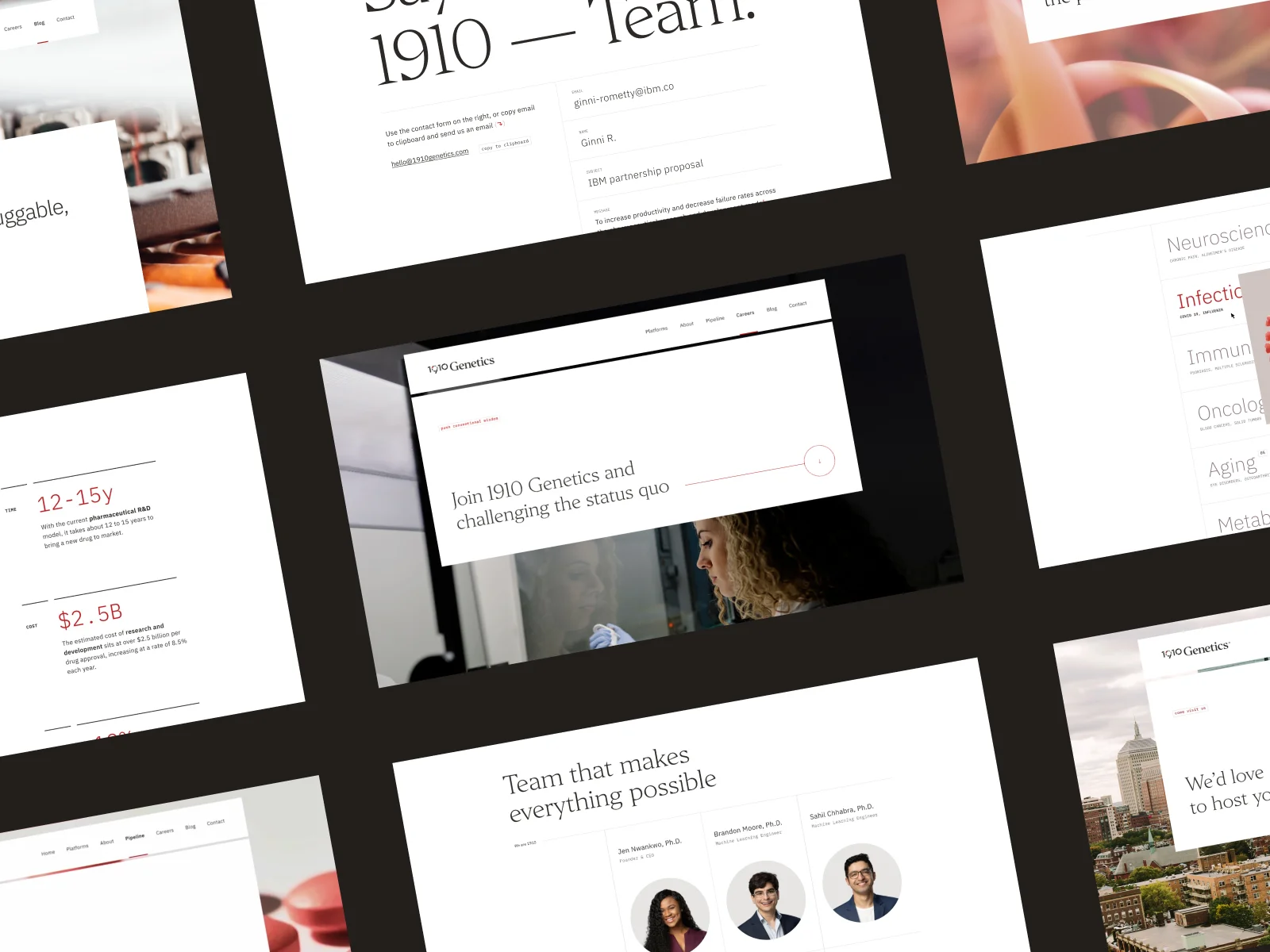
Use a reference like this to name the desired work: typography, platform explanation, imagery or motion. Do not turn its appearance into an unsupported budget benchmark. A supplier needs your approved material and deliverables to price the production.
Move the asset library with an explicit metadata contract
Agree which documents and images are current, which must remain available and which require controlled delivery. Required metadata might include an identifier, approved version, language, rights, owner and replacement relationship. Define these requirements from your actual operation.
Adobe provides a metadata import and export workflow. Its availability is a starting point for inspecting the source. The migration still needs a tested mapping to the destination library and a way to reconcile missing or changed records.
Ask who checks direct file addresses and links embedded in old pages. A document appearing in the new media library does not prove its previous audience can reach the correct version, or that a restricted file is protected.
Count languages, markets and approvals separately
A language is not always a market. Two countries may share a language while requiring different product information, contact destinations or publication permissions. Identify the relationship between a global source and each local variant before asking for a translation multiplier.
Allocate adaptation, terminology review and final approval. Agree how an approved global change is assessed locally, and what happens when a translation is not ready. The estimate should show who supplies the content and which review rounds or correction windows are included.
For the WordPress destination, define editorial roles and the required approval process. Native revision records are useful, but the existence of WordPress revisions does not prove that a particular build implements your approval policy.
Give integrations their own acceptance journeys
List forms, identity providers, CRM connections, search, analytics, consent tooling and external content feeds. For each dependency, name its owner, test environment, permitted data, failure behaviour and the team who can approve the result.
A form is not complete because a success message appears. Agree a permitted end-to-end test through the intended destination. An HCP journey needs its own access and market checks. Keep these journeys separate from a public-page rendering test.
If access to an external system is unavailable, price the discovery or interface agreement first. Do not describe an integration as a confirmed fixed-scope deliverable while its owner and contract remain unknown.
Include search continuity and release work
Provide the supplier with the URL inventory and relevant GSC evidence. Decide what each important address should do after release. Test response, destination, canonical and language relationships against that map. Retire content deliberately rather than sending every old path to the homepage.
Define content freeze, final import, changes made during the freeze, release authority and rollback conditions. If restoring an old environment would lose new enquiries or editorial changes, that consequence needs an agreed treatment before launch.
Include the post-release observation window, who investigates errors and what is covered by correction versus new scope. Our SEO migration work can be scoped alongside the platform move. Migration checks reduce avoidable mistakes; they do not guarantee unchanged rankings.
Use a sample migration to resolve the expensive unknowns
Commission a representative rehearsal before treating the full import as a mechanical task. Use the product, document, enquiry and historical URL in the fictional inventory above as different kinds of test record, then replace them with an agreed sample from your own estate. Choose exceptions as well as straightforward content: a missing language variant, a replaced document and a record shared by several pages.
The supplier should show the source-to-destination mapping and the resulting content in a reviewable environment. Ask an editor to correct a field and check the related page. Ask the document owner to identify the current file and its access rule. Record anything requiring manual correction or a new mapping decision. These are proposed acceptance tasks, not results from a migration we have performed for a client.
Use the findings to revise quantities and assumptions in the implementation proposal. Agree which defects the supplier corrects, which source problems your team resolves and how unresolved records are reported. This gives the next estimate a basis beyond “the export seems fine”.
A budget structure suppliers can actually fill in
- Assessment: access, inventory, representative export and unresolved decisions.
- Destination model: records, relationships, permissions and editorial operation.
- Design and build: component families, behaviours and agreed variations.
- Content and assets: mapping, transformation, import and reconciliation.
- Review: scientific, corporate, market and language responsibilities.
- Verification and release: journeys, URL checks, handover and correction window.
- Operation: hosting, maintenance, dependencies and internal ownership.
Ask for quantity, unit, assumptions, exclusions and acceptance beside every amount. Separate an optional redesign from essential migration work. Keep unresolved items as priced discovery or explicit provisional scope, with a decision point before implementation commitment.
A useful comparison follows this structure: one-off delivery, temporary overlap, ongoing operation and internal effort. Apply the same period to each proposal. Do not count an excluded task as a saving merely because someone else will have to do it.
What to send for a migration proposal
Prepare the current public website, platform and hosting context, content and asset inventory, component samples, languages and markets, integrations, review owners, contractual dates and desired launch window. Identify missing access rather than sending credentials through an open enquiry.
Ask the supplier to return a scope with evidence, dependencies and a bounded first stage. For a broader scientific-site brief, the 2027 biotech website RFP template covers audience and content decisions that may sit around the migration.
Can we get a fixed price before the audit?
A supplier can price a defined assessment. Committing the entire move requires enough evidence to bound content, behaviour and dependencies. Otherwise, the exclusions deserve as much attention as the total.
Does a migration include redesign?
Only when the scope says so. Agree what is retained, adapted and newly designed, then identify the content review caused by those changes.
Will WordPress automatically cost less to operate?
Compare the proposed hosting, support, integrations and internal work with your actual baseline. The platform name alone does not establish the saving.
Discuss your AEM migration scope with CODE GxP. Bring the inventory and the decisions still open. That is enough to start a useful assessment without pretending the whole project fits inside a page count.