A biotech website budget should explain how the company’s science, audiences and operating needs become a working publishing system. The useful number covers more than a collection of screens: scientific content, design, development, review, migration and the work required to keep the result accurate.
Prepare the inputs with our biotech website brief and RFP template for 2027. Its audience map, approved-source inventory and review responsibilities make the content, visual and development work in a proposal easier to compare.
For a 2027 project, start with the decisions the website must support. An early-stage company preparing for its next funding conversation has a different brief from a platform business explaining several programmes, recruiting internationally and maintaining a publication library. A page count can make those projects look remarkably similar. The effort rarely is.
This is a planning guide reviewed in October 2026, rather than a survey of agency prices. The examples below are hypothetical ways to compare scope. They are not published budgets for the reference projects or a fixed CODE GxP quotation. If you need a proposal, our biotech web design agency starts with the company stage, scientific material and launch requirements.
What does a biotech website actually need to do?
Give the budget three jobs before giving it a number. First, help a scientifically literate visitor understand the platform and its relevance. Second, give an investor, partner or prospective colleague an appropriate route into the evidence. Third, let the internal team publish a change without rebuilding the site or losing track of who approved it.
Those jobs translate into different content and technical requirements. A platform explanation may need an original diagram and careful terminology. Investor material may need dated presentations and clear corporate information. A publication collection needs structured records, filters and ownership. A recruitment route may simply link to a maintained external system. Treat each as a decision about the intended experience.
Write down the primary audience for each section and the next useful action. “Understand our approach and discuss a partnership” produces a more usable brief than “make it premium”. Both may appear in the same meeting; only one tells a delivery team what to build.
Three scope patterns to use in an early budget conversation
| Starting point | Work to make explicit | Typical scope question |
|---|---|---|
| Focused corporate launch | Company narrative, platform overview, team, contact and a manageable CMS | Is the scientific story already written and approved? |
| Platform and programme website | Audience journeys, scientific visuals, programme records, publications and reusable components | Which records change, and who owns their review? |
| International redesign | Content audit, language adaptation, migration, redirects, publishing permissions and launch coordination | What must survive from the existing site, and in which markets? |
These patterns can overlap. A small company can have a complex data or governance requirement; a large one can commission a deliberately focused corporate site. Use the table to expose work, rather than assign a company to a price bracket by headcount.
Ask for a base scope and separately priced options. That makes it possible to launch a useful first release while keeping an international rollout, an advanced repository or a second visual story as a visible later decision.
Scientific content can change the budget before design begins
There is a substantial difference between editing an approved narrative and discovering that narrative from papers, presentations and interviews. State which source material exists, its status and the people available to resolve scientific questions. Include the number of review rounds and the expected response process.
For every important claim, identify a source and an internal owner. The design and development team can structure references and make review easier; the appropriate company experts must confirm the scientific meaning and release suitability. A visually convincing diagram still needs an accountable scientific review.
Separate writing, editing, illustration and animation in the proposal. They often share a story but require different work. If animation is optional, establish the static explanation that will carry the message when motion is unavailable or unsuitable.
Use design references to discuss deliverables
A reference becomes useful when you can name the decision it illustrates. The 1910 Genetics presentation brings its brand and computational platforms into a distinctive visual system. It is a productive conversation starter for hierarchy, imagery and the relationship between a platform and the wider company.
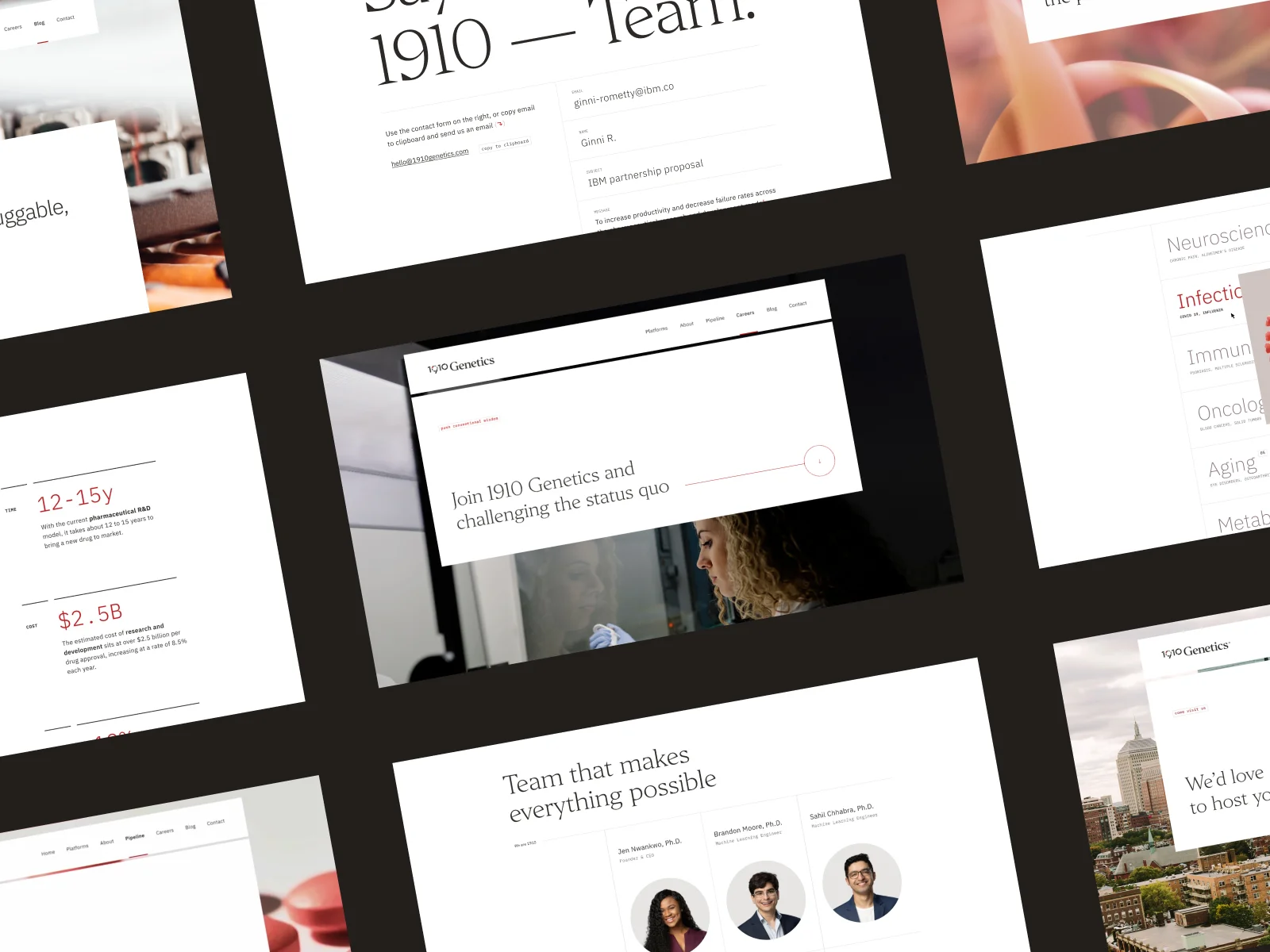
Bring two or three references into the brief and annotate what you value: an understandable platform diagram, a disciplined publication layout or a recognisable identity across screens. Then ask which original assets and components your own project requires. A reference cannot establish another company’s production effort or justify copying its visual work.
Our biotech website design references for 2027 give that discussion more visual context. The budget should turn the selected principles into your own deliverables.
Budget for a content model, not only finished pages
A programme, publication, team member and news item have different fields and lifecycles. Define those records before estimating the CMS. A publication might need a title, authors, journal, date, persistent reference and an optional external link. A programme may need a stage label whose wording and update responsibility are tightly controlled.
Now distinguish the first population of content from future editing. Who imports the existing records? Who resolves missing fields? Can the team change the order of programmes, withdraw a document or preview a new page without a developer? Those decisions shape the administration interface and acceptance tests.
Count unique templates and meaningful states alongside the number of pages. Ten pages built from three well-defined templates can involve less work than four pages with unrelated interactive explanations. Ask the agency to show both counts in its estimate.
Make migration a named workstream
A redesign inherits a public footprint: indexed URLs, downloaded documents, links from publications, partner references and recruitment campaigns. Inventory those routes and decide which continue, which change and which genuinely disappear. Budget for mapping and verification as well as moving text.
Separate a content migration from a platform migration. Reusing a CMS can still involve a demanding rewrite and restructuring. Replacing the CMS can be relatively contained when the approved material is small and consistent. The difficulty depends on what must be retained and transformed.
For the launch, name the owner of DNS, hosting, analytics and external services. State which dependencies the agency controls and which require company IT or another supplier. A late access issue can consume a carefully planned launch window without producing a single visible design change.
Include review and acceptance in the estimate
A proposal should explain how the company will review content and interfaces, how comments become decisions and how a revised version is approved. Different scientific, corporate and technical reviewers may need different evidence. One shared feedback process helps prevent contradictory instructions reaching production.
Ask for concrete acceptance examples: a team member can publish a reviewed record; a publication filter works with representative data; the approved terminology remains consistent; a keyboard user can complete the relevant form; and the agreed important URLs respond as intended after launch.
For audience-restricted experiences, such as an HCP portal, define that project separately from the public corporate website. Identity, access rules and restricted content can change architecture and review needs. The HCP portal development service and the public website can share an identity while requiring distinct scopes.
A simple budget model that exposes the assumptions
Ask each supplier to separate discovery, content, design, implementation, migration, testing and handover. Add third-party costs and ongoing services as separate lines. For an early estimate, a range with explicit assumptions is more useful than a precise number supported by an unspecified “standard website”.
Use this planning equation:
Launch investment = agreed delivery work + content and media production + migration + third-party setup + explicitly identified uncertainty.
Uncertainty should have a reason and an owner. For example, an undocumented publication export can be assessed during discovery. It should not remain a permanent allowance that nobody revisits. Ask what evidence will narrow the range and when that decision will happen.
For a hypothetical project, imagine that the first quote assumes supplied scientific copy, while the second includes interviews, writing and original illustrations. Comparing only their totals rewards an incomplete comparison. Put both proposals onto the same scope sheet before choosing.
A worked comparison: the funding milestone and the full redesign
Imagine a company with an approaching investor presentation. Its current platform story is approved, but the website cannot publish programmes and team changes cleanly. One possible first release rebuilds those records and the core corporate pages, preserving useful material and establishing a maintainable design system. A later release can add a more extensive scientific narrative.
Compare that with a proposal that includes new scientific interviews, original illustrations, a publication migration and several language versions immediately. The second scope may be appropriate, but the two totals answer different questions. A useful estimate identifies the launch-critical work and makes the wider ambition visible as an option.
Ask what would be reused between releases and what would need to be repeated. Staging can reduce the first commitment; it can also create duplicated review or production work if dependencies are poorly planned. Keep the investment conversation attached to the company milestone and a realistic route beyond it.
Account for the work after launch
List hosting, software, monitoring, maintenance, content ownership and planned improvements. Separate a supplier’s recurring fees from your own team’s editing and review time. Both affect the operating cost, even if only one appears on the agency invoice.
A useful comparison period is one you can reasonably plan for. For example, a three-year view can combine the launch scope with thirty-six months of recurring commitments and specific planned releases. Keep variable services and unknown expansion separate instead of presenting an unrealistically fixed total.
Confirm who owns the domain, code, design files, CMS access and commissioned assets, and which third-party licences have continuing conditions. The handover should give the business a practical route to maintain or move the website. It should also identify the support arrangements needed to do that responsibly.
What to send when requesting a biotech website quote
- The company stage, main audiences and decisions the website must support.
- The current site and a list of material worth retaining.
- Scientific copy, presentations, publications and visual assets, with their review status.
- The required content records, languages and external systems.
- A launch constraint with its business reason and known dependencies.
- The internal reviewers and the person who can resolve conflicting feedback.
- Two or three annotated design references and the investment constraints the team should respect.
That brief gives a supplier enough information to explain what is included, what needs discovery and which options could wait. It also lets the company recognise a proposal that understands the science and the publishing work, rather than merely repeating the requested page names.
Questions worth resolving before appointment
Can a small biotech start with a focused website?
Yes. Define the company and platform story, evidence routes and publishing needs that matter now. Record deferred features and the assumptions needed to add them later. A focused release still needs appropriate content, review, accessibility and launch checks.
Should an existing brand reduce the estimate?
It can reduce some discovery and identity work when the assets are usable and the guidelines answer the digital brief. Ask what still requires original design, illustration, production or adaptation. Possessing a logo does not settle every interface decision.
Can we compare a biotech quote with a general corporate website quote?
Compare the actual deliverables: source review, scientific communication, records, permissions, migration and testing. A general supplier may meet the brief, but the estimate needs to show how those responsibilities are covered.
For a scoped conversation, discuss your biotech website with CODE GxP. Bring the science, the audience and the constraints. We can turn those into a brief whose budget has something solid underneath it.